.

..

.

If Every Step Down the Stairs Feels Like a Nail Under Your Kneecap, Read This Before You Buy Another Knee Brace

A 97-person clinical trial, a set of X-rays and a Cleveland Clinic sports physician all point to one spot just under the kneecap. It's the one spot your brace was never built to target.

By the Health Headlines Journal health desk. Updated October 11, 2026.
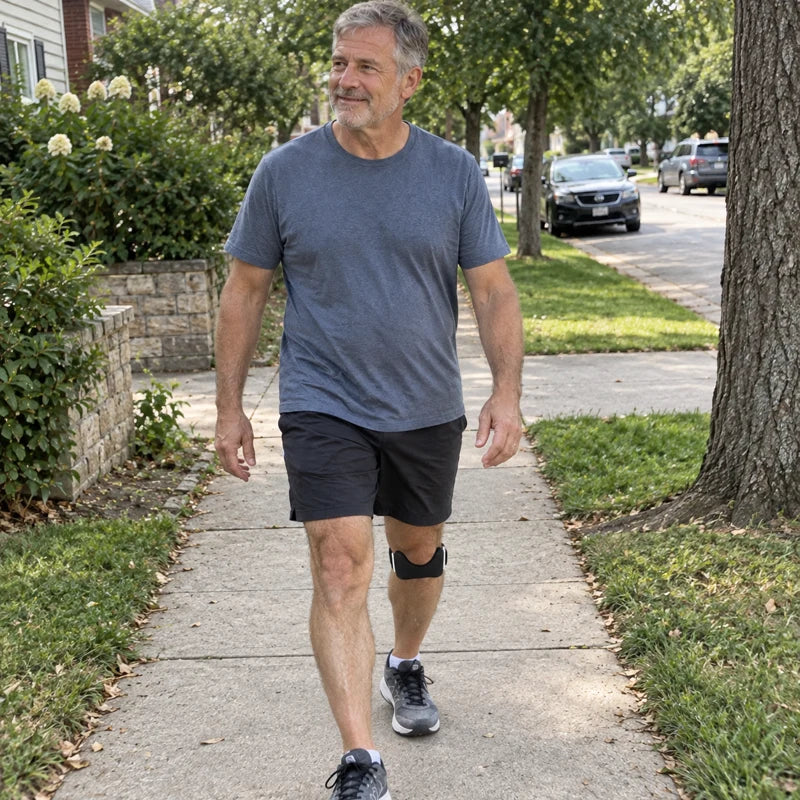
Mark R., 61, back on the two-mile lake loop he gave up in the spring of 2024.
man about 60 walking on a sidewalk

Inside this article:

  • The "Full-Wrap Mistake" almost every knee brace on the shelf is built around (and why it feels great for twenty minutes, then quits on you)
  • The 10-second thumb test a physical therapist used to find what four braces had missed
  • What X-rays of 20 men revealed about a strip of fabric no wider than your thumb
  • The 97-athlete trial where pain dropped during the one movement that hurts the most: a single-leg squat on a downhill slope
  • The placement mistake that makes a strip of fabric feel useless, and the 10-second fix

Mark R. kept his failures in the second drawer of his nightstand.

A thick neoprene sleeve from the pharmacy. An elastic one with a hole for the kneecap. A hinged brace with four Velcro straps his son-in-law swore by. A compression sleeve he ordered at 2 a.m. after a video promised "instant relief."

$187 of braces. One knee. Same ending every time.

They all felt great for about twenty minutes. Then my leg was hot, the thing was sliding down my calf, and the stairs still hurt.

Mark R., 61, retired HVAC contractor, Toledo, Ohio

If you've lived with a knee like that, you know the drawer. Maybe yours is a closet shelf. Maybe it's the trunk of your car.

And you know what every brace in there was built to do.

Squeeze more of your knee.

Not one of them asked the obvious question.

What if the pain that bites on the stairs, on hills, every time you get up from the couch, lives in one spot the size of your thumb, and every brace you've bought has been squeezing everything except that spot?

For Mark, the answer came from a physical therapist, one thumb and about ten seconds. What she pulled out of her desk drawer next made him laugh out loud. Six weeks later, he was back on the lake loop with Carol.

It's also the question sports medicine researchers have spent over a decade testing, with X-ray machines, force plates and a randomized trial. What they found is why this article exists.

Read to the end and you'll see why a strip of fabric that looks too small to matter changed the pain scores in a 97-person clinical trial, the X-ray study that shows how, and the one placement rule that makes or breaks the whole thing.

Who this is for. Pain at the front of your knee, around or just below the kneecap. Worse going down stairs, downhill, squatting, kneeling, or standing up after you've been sitting a while. You can still walk. You just hate what it costs you.

Who it's not for. If your knee locks, gives out under you, or swells like a grapefruit, close this tab and see a doctor. Nothing in this article is for that.

I never wanted to run a marathon again. I just wanted to stop thinking about my knee every time I left the house.

Linda M., 58, Sarasota, FL

Keep reading. Especially if your first reaction, like Mark's, is going to be "that thing is too small to do anything."

That reaction turns out to be the most interesting part of the story.

"I started scouting for benches"

Mark spent 34 years crawling through attics and kneeling on concrete. He figured his knees would send him a bill someday. He didn't expect it to arrive one step at a time.

It started on the stairs. Going down, never up. A hot, sharp pinch just under the kneecap, like someone pressing a nail into it every time his weight landed. Soon he was gripping the handrail like his life depended on it, every single trip down.

Then it was getting up from the couch. Then the toilet. Then the low folding chairs at his granddaughter's school play, where he had to grip the seat in front of him and push himself up while the parents behind him waited.

He did what everyone does. Ibuprofen with breakfast. A pharmacy sleeve. A bigger brace. A bigger one after that.

His doctor just shrugged. "It's your age, Mark. Keep taking the ibuprofen, and when it gets bad enough, we'll talk about a new knee."

And his world started shrinking so slowly he didn't notice.

He parked closer to the store. He took the elevator at the mall. He cut the Saturday lake loop with his wife, Carol, from two miles to one, then to "you go ahead, I'll wait in the car." When the grandkids wanted the zoo, he told them he'd "catch the next one," because the zoo is three hours on your feet and one long hill. Every plan started with the same two questions: how far is the walk, and how many stairs?

The worst part was scouting for benches. I'd walk into a place and the first thing I did was look for somewhere to sit. That's not who I was.

Mark R.

Underneath all of it was one fear he never said out loud. The next stop is a surgeon. A new knee. Weeks on a walker. Becoming the guy who needs help getting out of the car.

The low point was a Saturday in April. Carol walked the loop alone. Mark sat in the truck with the window down and watched her disappear around the bend. Forty-one years of walking that loop together, and he was watching it from a parking lot.

I thought, I'm 61, not 91. Something's wrong with how I'm going at this.

Mark R.

He was right. And it took a physical therapist about ten seconds to find what four braces had missed.

The 10-second thumb test that found his real problem

Carol stopped asking and booked him a physical therapist herself. On the first visit, the therapist pressed one thumb into the soft spot just under his kneecap.

Mark nearly came off the table.

"That's your spot," she said. "Not the whole knee. That spot."

Then she opened a drawer and pulled out something that made him laugh out loud: a narrow band, maybe an inch and a half wide, with a small firm pad in the middle.

"You're telling me that replaces the big brace?"

Her answer is the sentence this whole article hangs on.

Don't think of it as a smaller brace. It does a different job.

Mark's physical therapist

Mark went home and did what skeptics do. He typed "patellar strap" into Google, expecting TikTok nonsense.

He found the Cleveland Clinic instead. Then PubMed.

That's where the story stops being about a strap and starts being about biomechanics.

Part 1: The Full-Wrap Mistake almost every knee brace makes

Here's what nobody in the brace aisle will tell you.

Your knee isn't one thing. There's the kneecap. Behind it, cartilage. On the sides, ligaments. And just below the kneecap, a thick cord of tissue about the width of your thumb that connects the kneecap to your shin bone. The patellar tendon.

Every time you step down, your thigh muscle pulls through the kneecap and through that tendon to lower your whole body weight onto a bending knee. That's the load path. That short cord takes the hit.

That's why so many people get told it's "just age." For a lot of them, it isn't. It's where the load lands.

Where the force of every step lands: the patellar tendon, directly below the kneecap.

Now look at what a sleeve or a wrap-around brace actually does.

It squeezes evenly around the whole joint. The front, the back, the sides, the parts that never complained. The one spot carrying the load gets the same treatment as everything else.

Compression feels like something. Warmth, a little snugness, the sense that your knee is "held." That's why the first twenty minutes feel great.

Then the heat builds, the sleeve slides, and the spot that hurt is still doing the same job under the same load.

You've been watering the whole lawn to fix one dead patch.

Full wrap vs. one point

Knee sleeve or brace
Patellar strap
Patellar strap

Where the pressure goes

Spread over the whole knee

One firm point, on the tendon

The spot that hurts

Still carries the load

Gets the support

After 20 minutes

Hot, sliding down

Stays put, knee stays open

Under jeans

Bulky, it shows

Flat, nobody sees it

This is the Full-Wrap Mistake. And it isn't your fault.

The brace aisle runs on one idea: more coverage, more support. Bigger brace, bigger price tag. Nobody in that aisle makes money telling you the problem is one spot the size of your thumb.

Sports medicine dropped that idea years ago for this kind of front-of-knee pain. They even gave it a name: jumper's knee, or patellar tendinopathy. And they built a tool for it that's the exact opposite of a sleeve.

Bottom line A sleeve covers everything except the problem.

Then they did something no brace company bothers to do. They put it under an X-ray.

Part 2: What X-rays of 20 knees revealed about a strip of fabric

If you only read one study in this article, make it this one.

Researchers took 20 adult men and X-rayed their knees twice: once bare, once wearing an infrapatellar strap (the technical name for a band worn just under the kneecap). Then they fed the images into a computer model that estimates how much strain the patellar tendon takes during a landing.

The strap did two measurable things. It changed the angle between the kneecap and the tendon, and it changed the effective working length of the tendon.

The result: the predicted strain at the exact site where jumper's knee develops went down in most of them.

20 men. X-rayed with and without a strap.

The strap changed the kneecap-to-tendon angle and lowered the predicted strain at the lesion site.

Source: Infrapatellar Straps Decrease Patellar Tendon Strain at the Site of the Jumper's Knee Lesion. PubMed 23016021.

Read that again. It's the whole mechanism in one sentence.

A strap doesn't hold your knee together. It changes the geometry of where the force goes.

That's why it doesn't need to be big.

A second team checked whether that shows up in real life. They took 30 people with patellar tendinopathy and 30 healthy controls and had them land on one leg, with and without a strap, on a force plate.
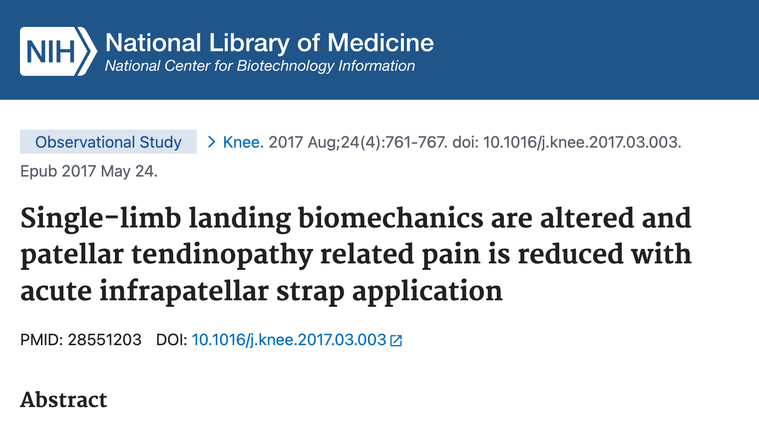
The landing study, as indexed in the US National Library of Medicine.
screenshot of the landing study listing in PubMed (National Library of Medicine)
37.1pain score with no strap (0 to 100)
28.0pain score with the strap
30adults with patellar tendinopathy, single-leg landing

Source: Single-limb landing biomechanics are altered and patellar tendinopathy related pain is reduced with acute infrapatellar strap application. PubMed 28551203.

Here's the part that convinced me. Pain wasn't the only number that moved. The researchers recorded changes in hip rotation, knee adduction, ankle inversion and peak ground reaction force.

They didn't just report less pain. They landed differently.

So no, it's not "just a tight band on your leg."

Bottom line The strap changed the tendon angle and lowered the predicted strain right where it hurts.

But a better angle on an X-ray is one thing. Less pain on a real staircase is another.
Part 3: Why smaller worked where bigger failed

Which brings us back to the question Mark asked out loud in that PT office.

How can something that small do more than a brace five times its size?

Because it isn't trying to "support" the way a sleeve does. It presses one firm point into the tendon just below the kneecap, and that single point of pressure is what moves the angle, the tendon length and the load.

So the size isn't a weakness.

It's small because of how it works. Not in spite of it.

A sleeve can't do this, no matter what it costs. Squeezing evenly is the one thing that prevents it.

Now, does it hold up outside a lab model?

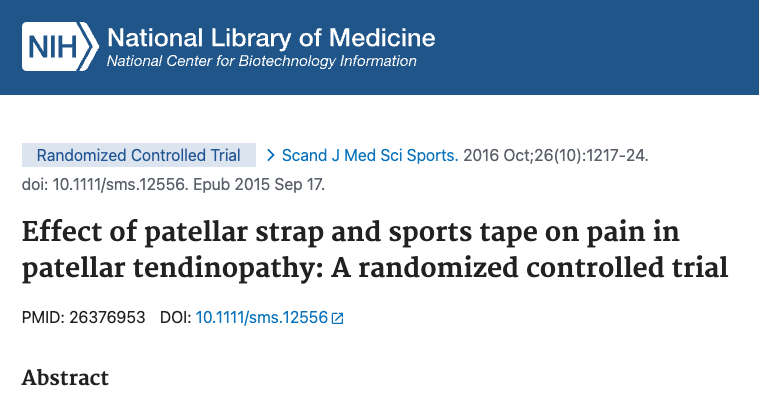
The clinical trial. De Vries and colleagues, published in the Scandinavian Journal of Medicine & Science in Sports, randomized 97 athletes with patellar tendinopathy through four conditions: a patellar strap, sports tape, placebo tape and nothing at all. The test was the single-leg decline squat, the standard way to provoke exactly this pain.

With the strap, pain during the squat was 14 mm lower on a 100 mm scale than with no support (p = 0.04). The strap group also reported less pain two hours after sport.

The trial, as indexed in the US National Library of Medicine.
screenshot of the trial listing in PubMed (National Library of Medicine)
97athletes in the randomized controlled trial
14 mmlower pain during the loaded squat vs. control (p = 0.04)
9randomized trials in the systematic review

Sources: de Vries et al., Scand J Med Sci Sports, PubMed 26376953. Systematic review of non-surgical treatment of patellar tendinopathy, PubMed 31606317.

The review. A systematic review of nine randomized controlled trials on non-surgical treatment for patellar tendinopathy found that patellar strapping and taping gave short-term pain relief.

On the court. Another study put infrapatellar straps on 16 basketball and volleyball players, ages 12 to 18, through squat jumps, drop jumps and 30-second jump tests. Not a lab mannequin. Kids under load.

The authority. In a 2026 piece on the Cleveland Clinic's own site, sports medicine physician Dominic King, DO, explains that a patellar band sits just below the kneecap and applies gentle pressure to the tendon, which can change how force is distributed through it, partially limit kneecap movement, add stability and help minimize irritation during movement.

His exact words: "It really is amazing what that little strap can do."

He lists the people who typically reach for one: runners, dancers, walkers and athletes in jumping sports.

Walkers. Mark underlined that.

Bottom line Less pain under load, in a 97-athlete randomized trial.

Mark's staircase test (you can run it too)

He ordered one, read the placement instructions twice and went to the bottom of his basement stairs.

Up: fine, same as always. Down: "The pinch was still there, but it was like someone turned the volume knob down. I went up and down six times to make sure I wasn't imagining it."

Six weeks later, he and Carol walked the whole two-mile loop. He didn't look for a single bench. And on the stairs at home, he doesn't hang on to the rail anymore.

Then the zoo, with the grandkids dragging him toward the elephants. Three hours on his feet, one long hill, and nobody had to wait for Grandpa.

The drawer's empty now. Gave the braces to my brother-in-law. He hasn't figured it out yet.

Mark R.

One detail he left out the first time we talked: it wasn't the first strap he tried.

Why most straps on the shelf won't do this job

Here's where most people quit.

Walk into a pharmacy and ask for a patellar strap. Most don't stock one. The ones that do sell a flat strip of foam with a single Velcro closure that slides down your shin by lunchtime.

Online it's the opposite problem: a hundred look-alike listings and no way to tell which one actually does what the research describes.

So Mark did what a contractor does. He wrote a spec sheet.

A strap that does this one job needs five things:

  1. A firm, contoured pressure pad. Not a flat band. The pad is the mechanism. If it's thin foam, you're back to a sleeve in miniature.
  2. Real adjustability. Dr. King's rule: firm, never a tourniquet. No numbness, no tingling. That takes a strap you can dial in, not a one-size loop.
  3. Low profile. If it shows under jeans or bunches under dress pants, you'll stop wearing it. A strap in a drawer does nothing.
  4. Fits either knee. The pain often switches sides. Buying a left and a right is how you end up with two more drawer items.
  5. Goes on in seconds, standing up. No sitting on the floor threading Velcro.

He ordered three. Two of them ended up with the brother-in-law too.

The one that stayed on his knee is called Alyviu.

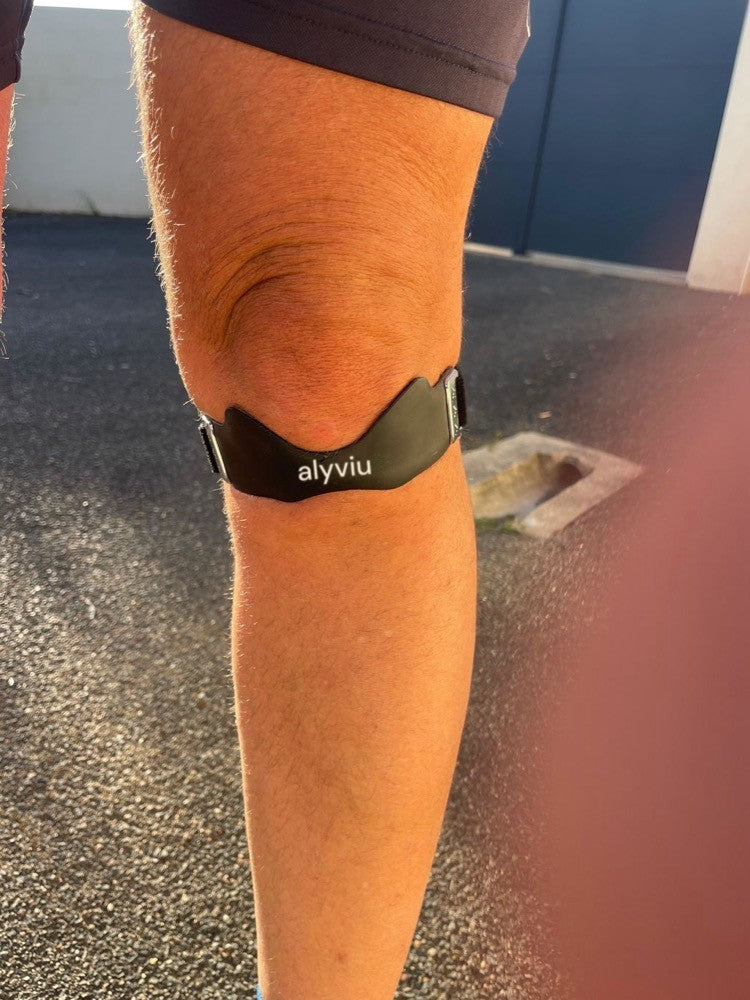
Alyviu Knee Strap, worn where the research says the pressure belongs: directly below the kneecap.
close-up of the Alyviu strap worn just below the kneecap

Alyviu is built around one idea, the same idea as the X-ray study: Single-Point Support. One contoured silicone pad, centered on the patellar tendon just below the kneecap. One adjustable band to hold it there. Nothing else on the knee.

That's the whole product. That's the point.

What you get, and what the first 60 days look like

What it is. A patellar strap with three parts, each doing one job:

  • The pad. Contoured silicone, firm, sits right on the tendon below the kneecap and grips the skin so it stays there. That's the Single-Point Support.
  • The band. Adjustable, so you set it firm enough to work and loose enough to forget. Right knee or left.
  • The profile. Low, light and breathable, so it lives under your pants and goes on in about ten seconds standing in the hallway.
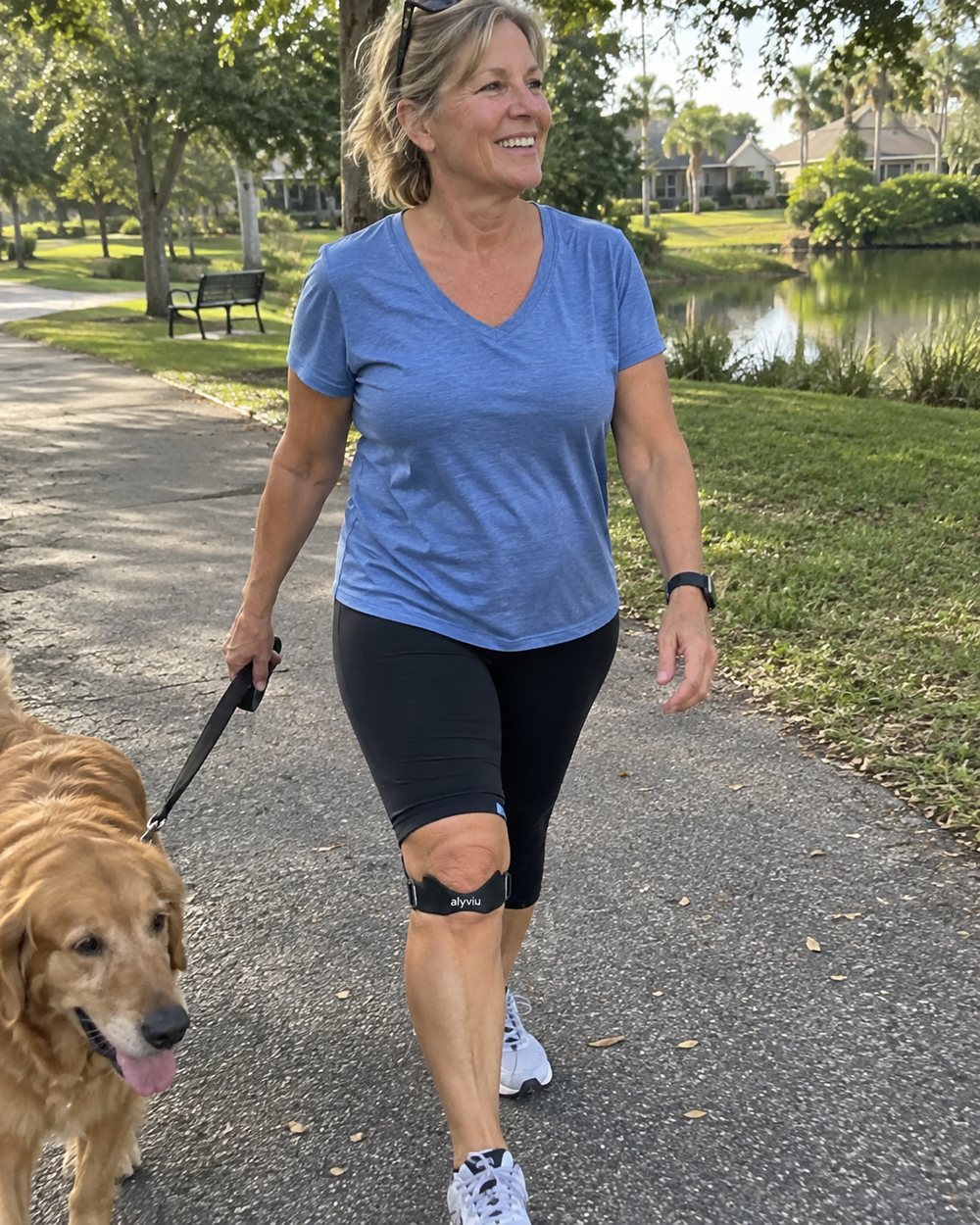
"I just wanted to enjoy my walks again."
woman about 60 walking her dog in a park, wearing the strap

I used to cut our walks short because my knee would start bothering me halfway through. I tried a bulky knee brace, but honestly, I hated wearing it. This little strap is so much more comfortable. I barely notice it's there, and I feel more supported when I'm out walking. Even my dog seems happier now that we're taking the longer route again!

Susan M., 54

What the first 60 days look like.

  • Today: it arrives, you put it on, you walk to the mailbox.
  • This week: you run your own staircase test. Down, not up. You'll know in six trips.
  • Weeks two to eight: walks, errands, the trip, the zoo, the long day on your feet. You find out what a normal day feels like with support in the right place.
  • Day 60: you decide whether it stays. If it doesn't, you get your money back. Details below.

Who it's for. People with front-of-knee pain that gets loud on stairs, hills and long days standing. Walkers, hikers, pickleball players, gardeners, grandparents, people who used to run and just want to walk without negotiating. Linda, who never called herself an athlete and only wanted to walk her dog without planning the route around benches.

What people who already wear it say

M. D.
★★★★★
M. D.
Verified customer, age 68

Walking without pain thanks to this strap

“I am 68 and have advanced knee osteoarthritis. I was limping when I walked, and the big knee braces were too bulky for me. This little strap takes 30 seconds to put on, and I am walking normally again. Why did none of the specialists ever tell me about something like this?”

C. V.
★★★★★
C. V.
Verified customer

No more pain on the stairs

“I had cartilage damage behind my kneecap and felt pain whenever I went down stairs. It felt as if my knee might give way. Since wearing this strap below my kneecap, I feel like my knee stays aligned.”

M. F.
★★★★★
M. F.
Verified customer

I am walking without a limp again

“My patellar tendon was inflamed, and I was limping. This strap has been a real relief: I walk normally, and the pain has almost disappeared. It is discreet enough to wear under jeans.”

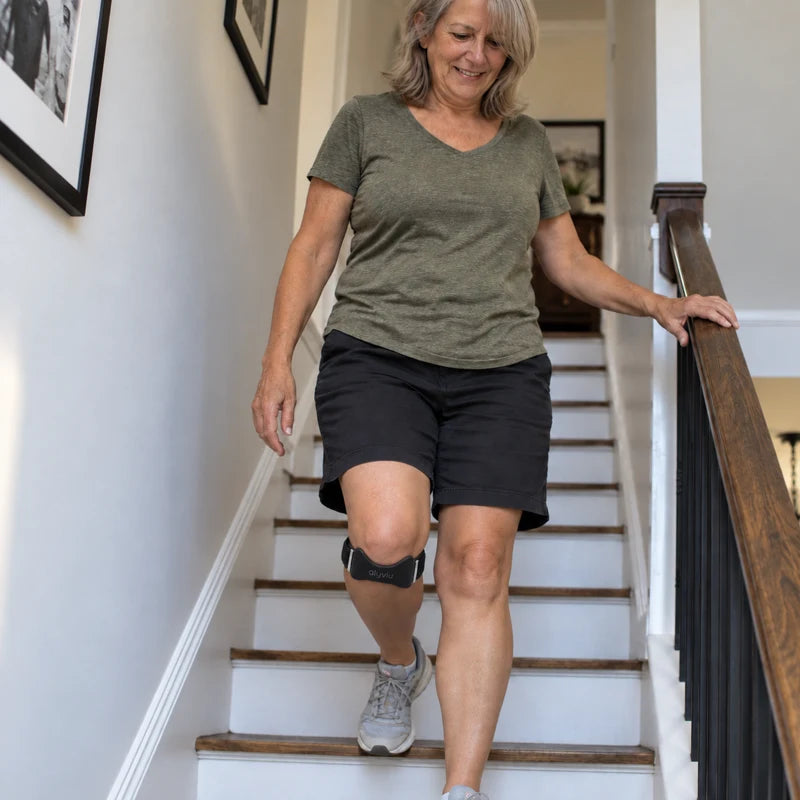
Down, not up. That's where you'll feel the difference first.
woman walking down the stairs at home wearing the strap

What's in the box. This is the part Mark didn't expect.

Alyviu is being introduced in the US as a Buy 1, Get 1 Free bundle. Two straps. One for each knee, or one at home and one in the car or the gym bag so you're never caught without it.

What it should cost. A knee replacement can run tens of thousands of dollars. Mark's drawer full of braces added up to $187. The clinic-brand straps he priced online ran $25 to $50 each. One physical therapy copay was $40.

What it costs. Two Alyviu Knee Straps, $29.90. That's $14.95 per knee. Less than the copay.

Buy 1 + Get 1 FREE 2 straps total. ¥2,490 per strap ¥4,980¥14,980 Ships in 48 hours $7.90 tracked shipping Best valueBuy 2 + Get 2 FREE 4 straps total. ¥1,995 per strapFree shipping ¥7,980¥29,980

4.72/5 from 202 reviews

Secure checkout

  • Visa
  • Mastercard
  • American Express
  • Apple Pay
  • Google Pay
  • PayPal

60-day money-back guaranteeNot for you? Full refund, and you keep the straps.

Want to see more photos first? View the product page

Before you decide: 60 days, and you keep the straps

If both knees talk to you, or you share a house with someone whose knees do, there's a second bundle: Buy 2, Get 2 Free, $49.90. Four straps at $12.48 each. Mark bought that one on his second order. One for Carol, one for the truck.

How ordering works. Tap the button. Pick your bundle. Check out. Ships within 48 hours, with tracking.

One honest thing. Dr. King is clear that a strap doesn't cure the cause of an injury. Mark didn't want a cure from a piece of fabric. He wanted his Saturdays back. That's a different purchase, and it's the only one we're talking about here.

The guarantee. Wear Alyviu for a full 60 days. Stairs, hills, trips, long shifts. If you're still grabbing the rail on the way down, if you haven't gotten back at least one thing you'd given up, email us for a full refund. No forms, no explanations. You keep the straps.

That's not a line we buried in the fine print. It's the only honest way to sell something whose first impression is "that's too small."

What ships with the bundle:

  • The Perfect Placement Card. The Cleveland Clinic rule (center of the pad directly on the tendon, below the kneecap, firm, never numb) printed where you will actually see it: inside the box.
  • The Stairs & Hills Protocol. A one-page, seven-day check-in. Which movements to test, in what order, so you know by day seven instead of guessing by day sixty.
  • Priority support. A real reply from a real person within one business day if the fit is not right.

Everything, stacked. Two Alyviu Knee Straps with Single-Point Support. The Placement Card. The seven-day Protocol. Priority support. Sixty days to decide, your money back if you decide no, and you keep the straps either way. $29.90.

The math Mark did in the truck. He'd already spent $187 proving that squeezing more of his knee didn't work. $29.90 to test the opposite idea, with his money back if he was wrong, wasn't a hard decision. It was the first easy one in a year.

Yes, send me 2 straps for $29.9060-day money-back guarantee. Ships within 48 hours. Fits right or left knee.

Two ways this goes

You can close this tab. The drawer stays full. The stairs keep charging their toll, one step at a time. And here's the part nobody tells you: every month you avoid the stairs, the muscles that hold your knee steady get weaker, so the stairs get harder, so you avoid them more. That loop only runs one way. The walk you skip this year becomes the walk you can't take next year.

Or a small box shows up this week. You find the soft spot under your kneecap, center the pad on it, tighten it until it's firm, and walk down your own stairs. Six trips. Then you know.

How to put it on (this is the part people get wrong)

finger pointing at the strap just below the kneecap

The most common reason a strap "doesn't work" is placement. People wear it on the kneecap, or two inches too low, where there's nothing to press.

Step 1: Sit with your knee slightly bent. Find the soft spot directly under the bottom edge of your kneecap, where your PT would press if she wanted you to jump.

Step 2: Center the pad on that spot. Not on the kneecap. Not down on the shin. On the tendon.

Step 3: Tighten until it's firm. If you feel numbness or tingling, it's too tight. Firm, not numb.

Then: walk down a flight of stairs. Six trips. Get this right and the X-ray study is working for you. Get it wrong and you're back to a sleeve in miniature.

Note: the Buy 1, Get 1 Free bundle is how Alyviu is being introduced in the US. It won't run forever. Check the current offer here.

Questions people ask before ordering

Does it fit the right knee and the left knee? Yes. It's the same strap for either side. The band adjusts, so there's no size chart and nothing to measure.

When do I wear it? Whenever you're up and moving: walks, stairs, errands, the trip, the long day on your feet. It's light enough to leave on all day and low enough to forget.

Will anyone see it? Not under jeans, dress pants or leggings. The pad sits flat below the kneecap.

How fast does it arrive? Ships within 48 hours, with tracking.

What if it doesn't work for me? You have 60 days. Email us, get a full refund, keep the straps. No forms, no return label.

Choose your bundle

Tap a bundle and you go straight to secure checkout. Buy 1 + Get 1 FREE covers one person, both knees. Buy 2 + Get 2 FREE covers two of you.

Buy 1 + Get 1 FREE 2 straps total. ¥2,490 per strap ¥4,980¥14,980 Ships in 48 hours $7.90 tracked shipping Best valueBuy 2 + Get 2 FREE 4 straps total. ¥1,995 per strapFree shipping ¥7,980¥29,980

4.72/5 from 202 reviews

Secure checkout

  • Visa
  • Mastercard
  • American Express
  • Apple Pay
  • Google Pay
  • PayPal

60-day money-back guaranteeNot for you? Full refund, and you keep the straps.